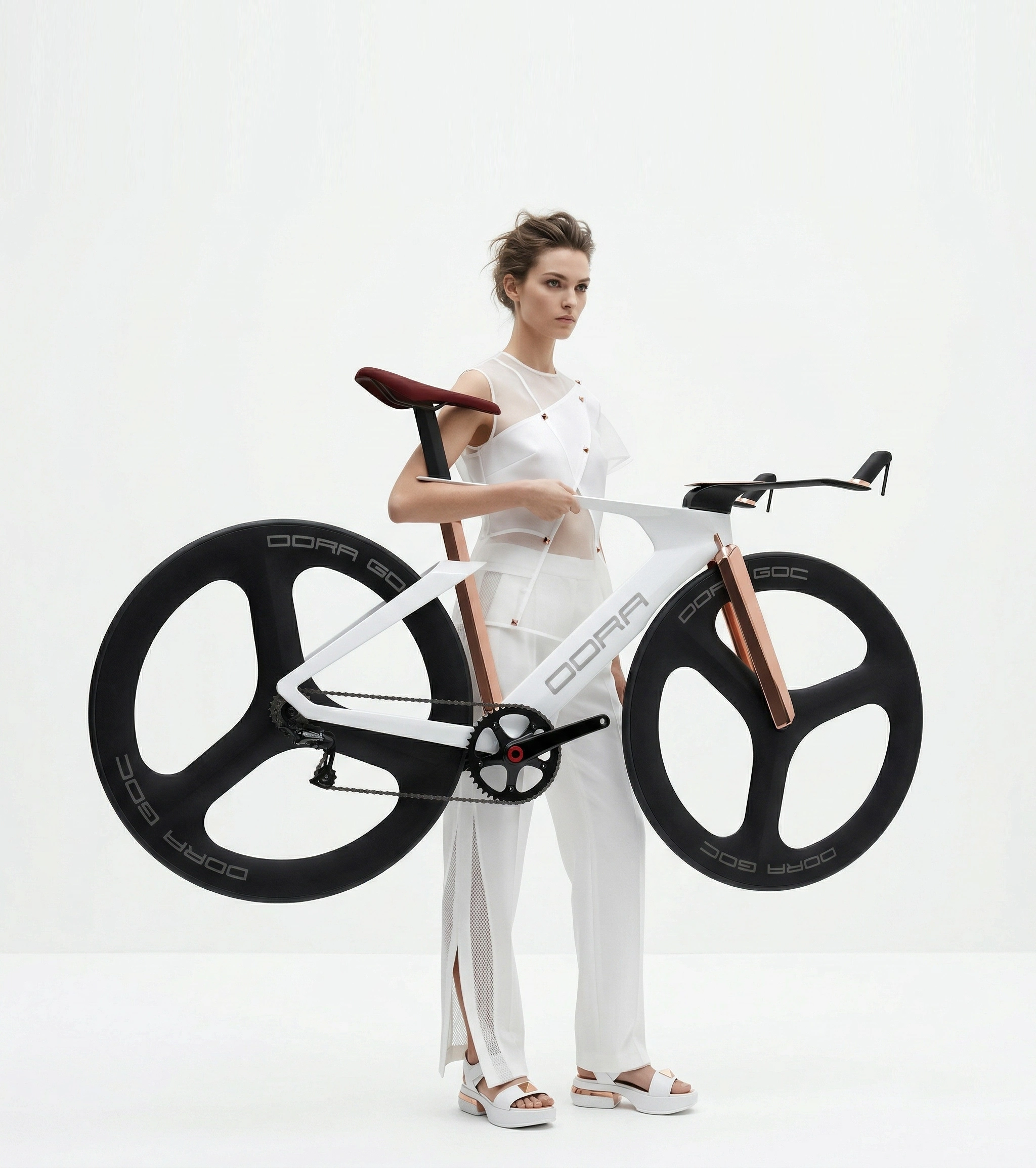
The concept explores the development of an exceptionally lightweight urban bicycle intended for users who regularly need to carry it into apartments, offices or other spaces located on the upper floors of buildings without lifts. Particular attention is given to the needs of girls and women, for whom the weight, width and instability of a conventional bicycle can often present a greater obstacle than riding itself. The aim is not to create a “women’s bicycle” in a decorative sense, but to develop a universal means of transport suited to users of lower physical strength or shorter stature.
With a total weight below 9 kg, the bicycle can be lifted and carried with one hand. The frame, fork, wheels, seatpost and handlebar assembly are made from carbon composites, while metal components are retained only where required for durability, joint precision and safe load transfer. This distribution of materials reduces weight without compromising the stiffness and reliability needed for everyday urban use.
The frame geometry is designed to make lifting easier and to keep the bicycle stable against the body. The central section of the frame serves as a natural carrying point positioned close to the bicycle’s centre of gravity, reducing unwanted rotation of the front or rear section while it is being carried. The gripping area may be slightly recessed, rounded and finished with a non-slip material to make carrying safer and more comfortable, even when climbing several flights of stairs.
One of the key features of the concept is a temporary steering-lock system. On a conventional bicycle, the front wheel and handlebar rotate freely, which means they can strike walls, railings, the user’s legs or the stairs while the bicycle is being carried. In narrow stairwells, this movement makes it more difficult to maintain balance and requires additional space.
The integrated temporary locking mechanism allows the handlebar and front wheel to be aligned with the bicycle’s longitudinal axis and held in a stable position. The mechanism may be activated by pressing a button, moving a lever or rotating a ring integrated into the steering assembly. The lock is not intended as an anti-theft device or as a permanent steering restraint, but solely to stabilise the bicycle while it is being carried, placed in a lift, taken through a doorway or stored in a narrow space.
The safety system must prevent the bicycle from being ridden while the steering is locked. This may be achieved through automatic release when the bicycle is placed on the ground, a clear visual indicator or a mechanism that cannot be fully engaged while the bicycle is in a riding position. The system should be lightweight, simple and resistant to dust, moisture and frequent everyday use.
The handlebar may be narrower than those used on standard urban bicycles to reduce the bicycle’s overall width when moving through corridors and stairwells. Folding pedals could further minimise the risk of catching on clothing, railings or walls. Smooth transitions without exposed bolts, sharp edges or protruding components would also help prevent the bicycle from snagging on bags or clothing.
The bicycle is conceived as an everyday urban tool rather than a sports product designed only for riding. Its usability is also evaluated when it is not in motion: while being lifted, carried, turned on a stair landing, taken through a doorway, stored inside an apartment or brought onto public transport. Portability is therefore treated as a primary function, equal in importance to handling, comfort and mechanical reliability.
The result is a lightweight, rigid and stable bicycle that behaves as a compact unit while being carried rather than as a collection of moving parts. Through temporary steering stabilisation, reduced weight and a carefully positioned centre of gravity, the bicycle becomes easier to use for people who find conventional urban models too heavy or cumbersome. Here, lightness is not merely a technical value, but a form of accessibility, independence and everyday freedom of movement.