


Goran Juric Design portfolio | 2025 | Lightweight Metal Reusable Bottle Concept Supplement or replacement for glass bottles in mass consumption | Independent Research
The project explores the systemic potential of replacing returnable glass bottles with thin-walled stainless-steel bottles within industrial refill networks. The aim is not merely to replace one packaging material with another, but to develop a lighter, stronger and longer-lasting bottle capable of becoming a permanent component of a reuse system.
Thanks to its high structural strength and impact resistance, stainless steel enables the production of bottles with significantly thinner walls and lower weight, while at the same time eliminating losses caused by breakage — one of the fundamental limitations of glass packaging. This reduces damage during filling, transport, storage and everyday use, as well as the need for additional protective packaging.
A greater number of refill cycles allows the initial emissions and energy consumption associated with the production of the metal bottle to be distributed over a substantially longer service life. Reduced weight directly improves transport energy efficiency, while resistance to breakage lowers material losses, replacement costs, operational downtime and insurance-related risks.
This transition is therefore not simply a replacement of glass with metal, but an optimisation of the entire refill infrastructure. In systems where glass bottles achieve a limited number of cycles due to breakage, damage and gradual removal from circulation, a thin-walled stainless-steel bottle offers the potential for a significantly longer and more stable service life.
The environmental performance of such a system is determined not only by the type of material used, but also by the total number of uses, packaging weight, replacement frequency, transport efficiency and the amount of waste avoided. Sustainability is not demonstrated through declarations, but through measurable durability across the product’s entire life cycle.
By eliminating fragility, packaging is transformed from a consumable item into permanent reuse infrastructure. Once a bottle is no longer vulnerable to breakage, its service life is no longer defined by material weakness. Durability then becomes the highest form of responsibility, while structural strength becomes a quiet environmental strategy — one that reduces waste not through messaging, but through longevity and resilience.
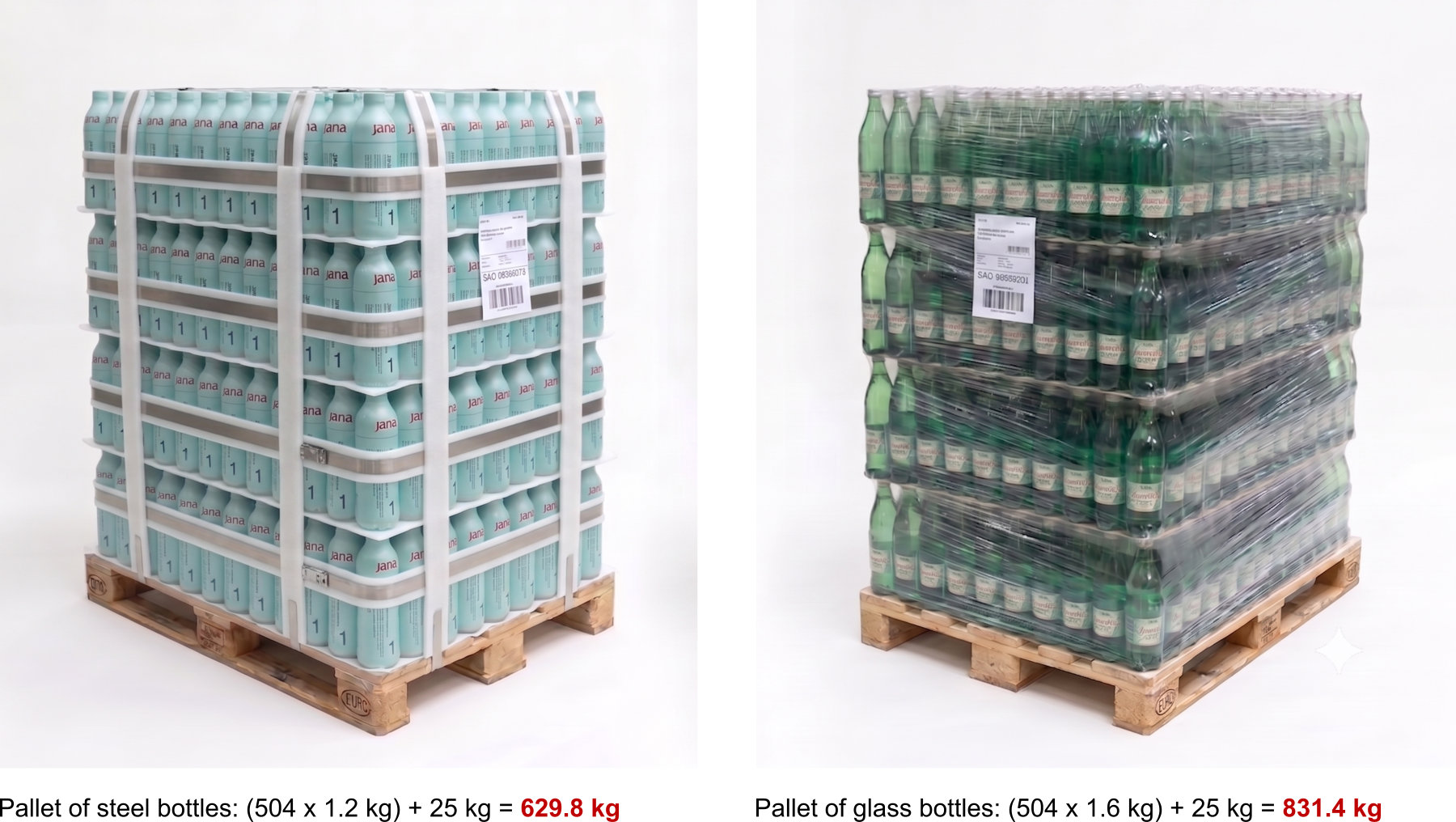
We decided to conduct a detailed mathematical and logistical analysis. What exactly happens when we replace a standard 1-liter glass bottle with a steel one? The results are, to say the least, impressive – from relief for your hands when carrying groceries from the store, to massive savings in global transport.
Here is what the numbers look like in practice.
1. Consumer Level: A Single Bottle
For starters, let’s look at the basic unit – a single 1-liter bottle. Due to pressure (if the water is carbonated) and the fragility of the material, glass needs to be thick. Steel does not.
-
Liquid mass (1 liter of water) in both cases is exactly 1 kg.
-
Glass bottle: An empty bottle weighs about 0.6 kg. A full bottle is 1.6 kg.
-
Steel bottle: An empty bottle weighs about 0.2 kg. A full bottle is 1.2 kg.
Even with just one bottle, the steel packaging is 400 grams lighter.
2. Family Grocery Shopping: A 6-Pack
Most of us buy water in practical 6-bottle carriers. This is where the difference in weight becomes very noticeable for the average buyer who has to carry the pack from the store to their home.
-
6 glass bottles: The empty packaging alone weighs 3.6 kg. When we add the water, you carry a total of 9.6 kg.
-
6 steel bottles: The empty packaging weighs only 1.2 kg. The full pack is 7.2 kg.
By purchasing steel bottles, the consumer carries 2.4 kilograms less “dead weight” home.
3. Warehouse and Logistics: A Single Europallet
Moving on to logistics. A standard Europallet (which itself weighs about 25 kg) usually holds 504 1-liter bottles (arranged in 4 layers of 21 6-packs).
-
Pallet of glass bottles: (504 x 1.6 kg) + 25 kg = 831.4 kg
-
Pallet of steel bottles: (504 x 1.2 kg) + 25 kg = 629.8 kg
Each pallet with steel bottles is lighter by an incredible 201.6 kg. This means less wear and tear on forklifts, a lower risk of warehouse worker injuries, and easier handling.
4. Warehouse Infrastructure: Pallet Racking and Retail Storage
The reduction in pallet weight also has important consequences for warehouse infrastructure. Palletised beverages are commonly stored in selective pallet racking systems within bottling plants, regional distribution centres, supermarket warehouses and back-of-house retail storage areas.
Each pallet of steel bottles weighs approximately 201.6 kg less than an equivalent pallet of glass bottles. In a rack level holding three pallets, this represents a reduction of approximately 604.8 kg. Across a rack bay containing four such storage levels, the total stored load may be reduced by approximately 2.4 tonnes.
On the scale of a warehouse holding 1,000 fully loaded pallets, lightweight steel bottles would reduce the total stored mass by more than 200 tonnes.
This lower static load reduces the burden placed on rack beams, upright frames, anchors and warehouse floor slabs. It also provides a greater operational safety margin within the certified load capacity of the racking system. During daily handling, lighter pallets place less mechanical stress on forklifts, lifting equipment and warehouse surfaces.
The benefit is particularly relevant in supermarket warehouses and compact back-of-house storage areas, where goods are moved frequently and where space, manoeuvrability and employee safety are critical operational factors.
Lower pallet weight does not automatically mean that additional pallets can be placed within an existing rack. Storage capacity remains determined by pallet dimensions, rack geometry, fire-safety requirements, floor capacity and the certified structural load of the installation. However, reducing the mass of every stored pallet makes the entire warehouse system less heavily loaded, easier to operate and potentially less demanding to maintain.
The transition from glass to lightweight steel packaging therefore affects not only the product and its transportation, but also the physical infrastructure through which the product moves and in which it is stored.
5. Transportation: A Single Semi-Truck
A standard semi-trailer truck on European roads holds exactly 33 Europallets. Here, the difference in packaging literally changes the game. Due to legal restrictions, the maximum payload capacity in a truck is usually around 24 tonnes (24,000 kg).
-
Truck with glass: 33 pallets x 831.4 kg = 27,436 kg (Note: This exceeds the standard 24-tonne payload capacity! This means a truck carrying glass often cannot even be loaded with a full 33 pallets, leaving some space empty).
-
Truck with steel: 33 pallets x 629.8 kg = 20,783 kg (Perfectly within limits, maximizing the use of space).
On just one full truck, steel packaging saves over 6.6 tonnes of freight weight! Imagine how much fuel is saved and how much less CO2 is emitted into the atmosphere on the journey from the bottling plant to the supermarket.
6. Macro Level: Yearly Factory Production
To look at the big picture, let’s take an average-sized water bottling plant that produces 10 million bottles (1-liter capacity) annually. How much material does the factory need to purchase, process, and transport on a yearly basis?
-
Annual mass of glass packaging: 10,000,000 x 0.6 kg = 6,000 tonnes of glass.
-
Annual mass of steel packaging: 10,000,000 x 0.2 kg = 2,000 tonnes of steel.
By switching to single-wall steel bottles, just one bottling plant would eliminate 4,000 tonnes of packaging weight every year. That’s hundreds upon hundreds of fewer trucks on our roads.
Although glass has a rich tradition, the numbers are relentless. The transition to lightweight single-wall steel bottles offers a drastic mass reduction at every level of the supply chain – from easier grocery carrying for consumers, to millions in logistics savings and a massive reduction in the carbon footprint for manufacturers.
Is it time for the water industry to say goodbye to glass and turn to steel? Logistics certainly says – yes.

